
The Letter that Rocked against Racism
05.09.26
50 years on Mark Perryman recalls the creation of Rock against Racism
I can still remember the scene. 1976-78, every Thursday morning, the sixth form common room, De Burgh Secondary School, Tadworth, Surrey. Groups, mainly boys, devouring the latest edition of the New Musical Express, or as it was known by all its readers, the NME. This was our social media, tweets in those days the sound of birds, tik tok the noise clocks made, the NME sold 250,000 copies a week, the weekly music press market big enough to support three other music titles too: Melody Maker, Sounds and the Record Mirror.
For me there was only one choice for my weekly music paper read, the NME. It reported on, championed and understood the fast-emerging punk scene, the Clash, Sex Pistols, Siouxsie and the Banshees live debuts were all in 1976. Uniquely tho' the NME combined the coverage with sharply worded rebel polemic in the shape of Julie Burchill and Tony Parsons. The pair of them rebels with a verbal cause. Or as they put it in their 96-page manifesto of the time "The Boy Looked at Johnny": The Obituary of Rock and Roll (I still have my copy, signed by Julie and Tony):
" Never mind, kid, there'll soon be another washing-machine/ spot-cream/ rock band on the market to solve all your problems and keep you quiet /off the street/distracted from the real enemy/content till the next pay-day."
A youthful punk ultra-leftism bearing little or no resemblance to what both have become, old school reactionaries.
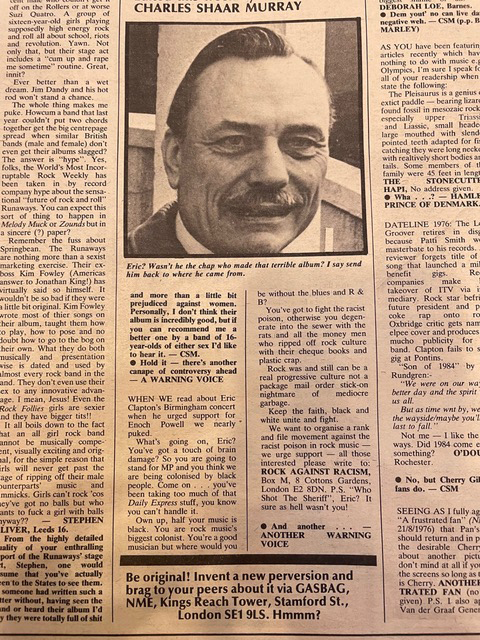
The NME 11 September 1976 issue carried a letter that captured rebel polemic precisely, this time aimed at one of the pillars of the rock establishment, Eric Clapton. In the course of his August Birmingham gig Clapton had chosen to share with his audience what he thought of the current state of Britain. In the course of what quickly turned into a diatribe he revealed himself as a supporter of the notorious racist politician Enoch Powell, a man so racist the leadership of his party, the Conservative Party, disowned him. In contrast Clapton urged the concert-goers to back Powell and stop Britain turning into a " black colony". If that wasn't bad enough he went on " get the foreigners out, get the wogs out, get the coons out." As a verbal backdrop Clapton interspersed this foul and grossly offensive tirade with repeatedly shouting into his mic the Nazi National Front slogan " Keep Britain White."
The letter brilliantly pointed out where Clapton's Rhythm and Blues came from:
"When we read about Eric Clapton’s Birmingham concert, when he urged support for Enoch Powell, we nearly puked. Come on Eric… Own up. Half your music is black. You’re rock music’s biggest colonist.... P. S. Who shot the Sheriff Eric? It sure as hell wasn’t you!”
The line 'Who Shot the Sheriff Eric? '(if readers don't get the musical reference check out here) the best of put-downs for a racist bigot using his platform to propagate more bigotry.
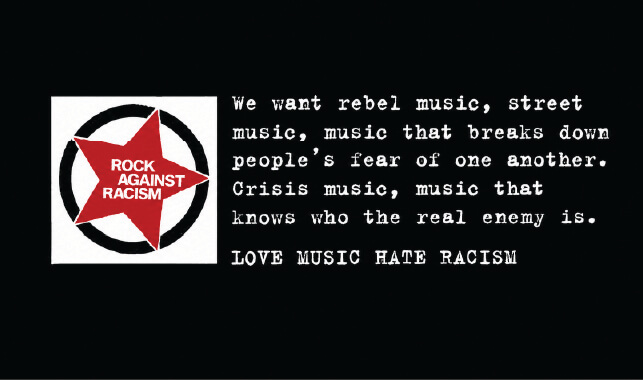
But the letter wasn't just about being 'anti', the classic default position of the left, but creating an alternative, something much harder but infinitely more effective and long-lasting:
"We want Rebel music, street music. Music that breaks down people’s fear of one another. Crisis music. Now music. Music that knows who the real enemy is."
Invited to sign up via a PO Box the response was both immediate and overwhelming, Rock against Racism the result. The urgent necessity in 1976 for such a movement shouldn't be underestimated.
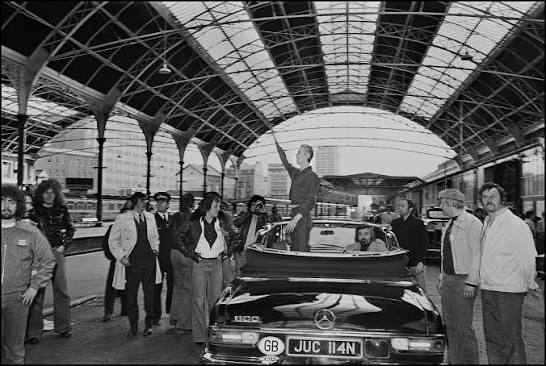
For his album released that same year Station to Station David Bowie adopted the persona of the 'Thin White Duke' whom he described, apparently approvingly, as a " very Aryan, fascist type." And in case of any doubts, Bowie in interviews promoting the album declared "Britain could benefit from a fascist leader" and championed Adolf Hitler as " one of the first rock stars" who "worked an audience". Yes Bowie, but not to get to Number One but send six million to the gas chambers and extermination. But unbowed, as a 1976 publicity stunt while promoting the album Bowie arrived at Victoria Station in a chauffeur driven open-top Mercedes, black-shirted with a salute to the waiting crowd that looked suspiciously of the Sieg Heil variety.
And while the 1976 birth of punk provided the mainstays for Rock against Racism's playlist of rebel, street, now, music there was an unhelpful habit of a mix of fashioning the swastika into shock value where two fingers, up yours was not enough with nazi chic for the punk fashion conscious. Meantime some punk bands, Sham 69 and the Angelic Upstarts in particular, despite their best efforts to shake them off attracted a far right following, while others, most notoriously Skrewdriver, went full-on fascist.
Much of punk subculture was framed by nihilism. The politics of the two-fingered salute. This coincided with rising unemployment and a resurgent racism from Powell to the National Front via Thatcher's barely coded description of the state of Britain: " if there is any fear that it might be swamped, people are going to be rather hostile to those coming in.” In that context punk's nihilism could have very easily ended with a far nastier intent than simply eff you.
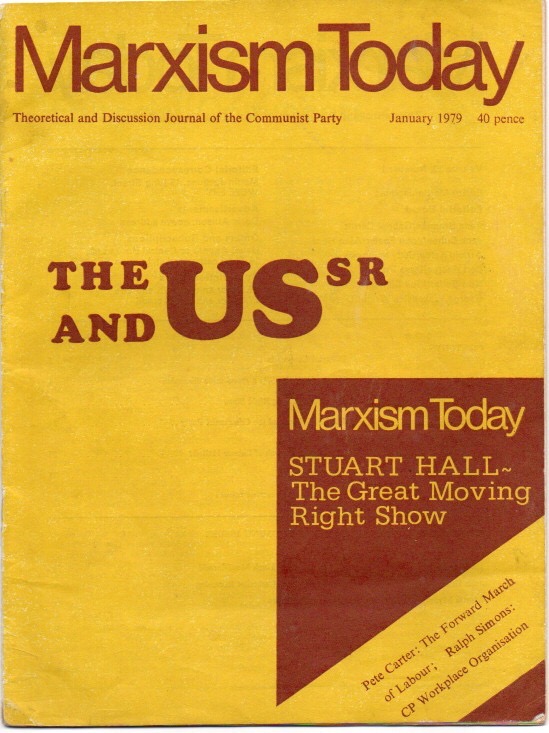
Thus Rock against Racism succeeded because it wasn't simply about the angry response sparked by one ageing rocker bigot, there was a far greater size of ambition that it embraced. It isn't a mark of failure that in 2026 we are lumbered with an unimiganable scale of far right populist racism scarcely challenged by he political mainstream. Thus, fifty years later understanding how this punky reggae politics largely succeeded, allied with one, my, generation's youthful sub-culture is needed now more than ever. In his January 1979 seminal Marxism Today essay 'The Great Moving Right Show' prefacing the Thatcherism to come Stuart Hall picked out as a sign of hope Rock against Racism "one of the timeliest and best constructed of cultural interventions, repaying serious and extended analysis." Not for the first time, hear, hear Stuart Hall.
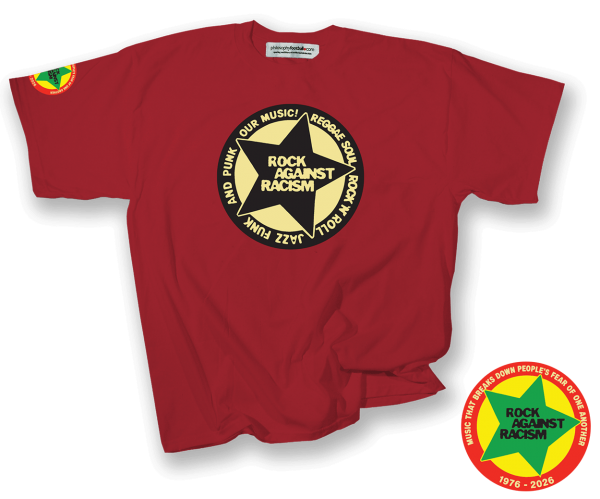
So while joyfully celebrating Rock against Racism's 50th I'm sorry to be a party-pooper but wearing badges, or in this instance, a T-shirt, is not enough. Unless, just like the authors of that 11 September 1976 letter to the NME, we share Rock against Racism's foundational ambition to "break down people’s fear of one another." Because without that collective intent there'll be no happy ending, ever.
The Rock against Racism 50th Anniversary T-shirt is available from Philosophy Football here
Mark Perryman is co-founder of Philosophy Football and contributor to Reminscences of RAR : Rocking against Racism 1976-82